
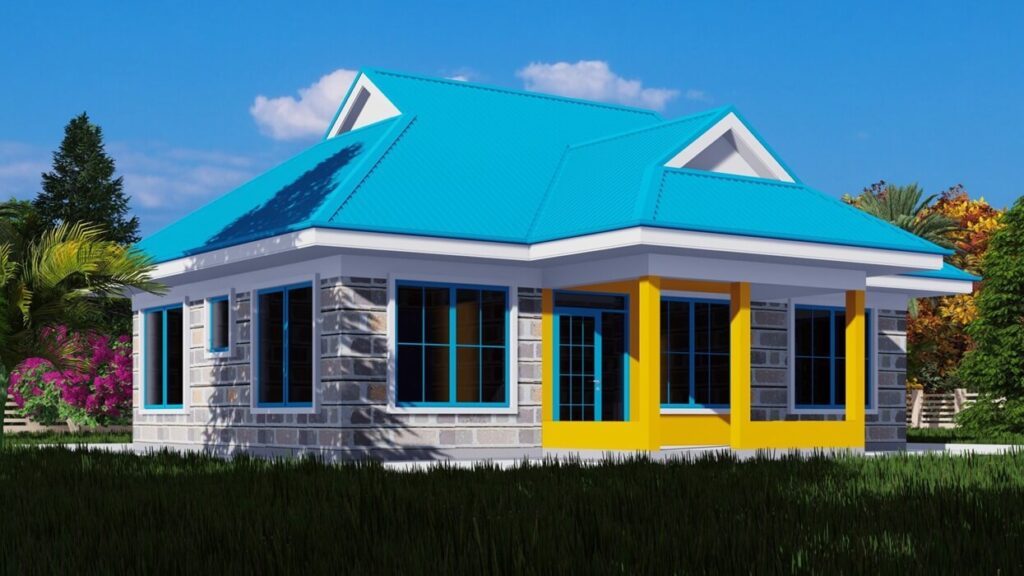
We’ve all been there. You’re sitting at a family gathering in the village, looking at that old semi-permanent house your grandfather built, and the dream hits you. You picture a modern, spacious 3-bedroom bungalow right there on the family land. You can already see yourself hosting Christmas lunch, with enough space for the kids to run around and a master ensuite that actually feels like a sanctuary.
But then, reality kicks in. You start asking around, and one uncle tells you it costs “very little,” while your cousin in the city says you need at least 10 million. Who do you believe?
At Durar, we deal with these questions every day. Building in rural Kenya—whether it’s in Central, Western, or the Coast—has its own unique rhythm and price tag. Let’s break down what it actually takes to move from a “plot” to a home in 2026.
The Magic Number: What’s the Total?
In 2026, building a standard 100 to 120 square-meter 3-bedroom bungalow in a rural area will generally cost you between KES 2.8 million and KES 4.5 million.
If you are looking for a “budget” build—think simple mabati roofing, standard ceramic tiles, and local stones—you can squeeze it toward the 2.8M to 3.2M mark. However, if you want those fancy gypsum ceilings, large aluminum windows, and a “decra” style roof, prepare to hit the 4.5M to 5.5M range.
1. The Foundation: Don’t Let the Soil Cheat You
Kenyans say, “Nyumba ni msingi.” And it’s true. In the village, your biggest enemy or friend is the soil. If you’re building in an area with “Red Soil,” you’re in luck—it’s stable and cheaper to work with.
But if you’re in a place with “Black Cotton” soil, pole sana. You’ll spend a lot more on excavation and hardcore because you have to dig deeper to find the firm ground. In 2026, expect to spend about KES 400,000 to 600,000 just to get out of the ground. This includes the “blinding,” the mesh (BRC), and that expensive waterproof polythene paper.
2. Walling and the “Fundi” Drama
This is where the house starts to look like a house. Most people in rural Kenya prefer machine-cut stones because they save on mortar and time. Currently, a single stone is going for about KES 30 to 40, depending on how far the quarry is from your shamba.
For a 3-bedroom house, you’ll need roughly 3,500 to 5,000 stones. Add about 150 bags of cement (now retailing at KES 750 to 850) and several lorries of sand.
Pro Tip: Don’t just hire any fundi because he’s a “neighbor.” We’ve seen walls that look like the Leaning Tower of Pisa because someone wanted to save KES 500 on daily wages. A good foreman will save you more money in the long run by reducing material wastage.
3. The Roof: To “Mabati” or Not?
The roof is often the most expensive single part of the build. In 2026, everyone wants the “Box Profile” or “Stone-coated” look. It’s stylish and makes the house pop.
For a 3-bedroom unit, the roofing structure (timber) and the sheets will cost you anywhere from KES 400,000 to 750,000. If you go for the premium stone-coated tiles, your budget will definitely lean toward the higher side.
4. Finishes: Where the Money “Disappears”
You’ve finished the structure, and you think you’re almost done. Then you start looking at tiles, paint, and electrical fittings. This is the “black hole” of construction.
Kenyans love a good “Tile Center” visit, but remember:
- Floor Tiles: Budget KES 1,200 to 2,500 per square meter.
- Windows: Aluminum is the trend now because it doesn’t rust and looks clean.
- Doors: A good mahogany main door can set you back KES 40,000, while internal flush doors are around KES 10,000.
The Relatable “Hidden” Costs
Building in the village isn’t just about cement and stones. There’s the “Logistics” of it all.
- Transport: That lorry of sand might cost KES 20,000 in town but KES 35,000 by the time it reaches your remote village because of the bad roads.
- Feeding the Crew: In rural areas, it’s tradition to provide tea and sometimes lunch for the fundis. It seems small, but over six months, those “mandazis” and “githeri” plates add up!
- Water: If there’s no piped water, you’ll be buying water by the donkey or bowser. Construction is “thirsty” work.
Why Partner with Durar?
Building your dream home shouldn’t feel like a punishment. At Durar, we specialize in taking the “stres” out of the “mjengo” process. We don’t just give you a drawing; we give you a roadmap.
Whether you’re in the diaspora or working in the city, we ensure your rural project moves forward without you having to fight with fundis over the phone every Saturday morning. We handle the design, the structural integrity, and the supervision so that when you finally take that key, the house actually looks like the dream you had.
Ready to start your rural project? Let’s talk about your vision and get you a realistic quote that won’t give you a headache.
Are you planning to start your foundation this year, or are you still in the “saving and dreaming” phase?